
Disability Justice
First UU Congregational Accessibility Project
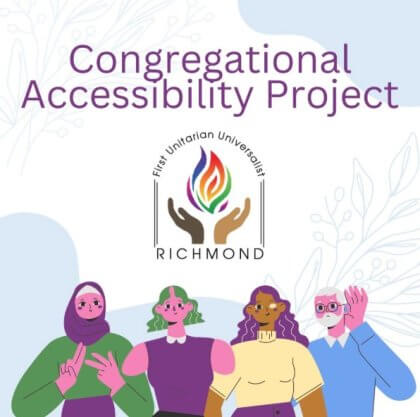 Transcribed Text:
Congregational Accessibility Project
First Unitarian Universalist Richmond
We are using resources from EqUUal Access, a UUA disability affinity group, to evaluate our accessibility and create suggestions to increase accessibility and inclusion. Do you have a specific concern about accessibility at First UU? Send an explanation of your concern and your contact information to our new email, and one of the members of the Accessibility Project team will follow up with you. DEI is a human strategy.
Contact: accessibility@richmonduu.org
We are Unitarian Universalists living with disabilities, our families, friends, and allies coming together for a common purpose:
To enable the full engagement of people with disabilities in Unitarian Universalist communities and the broader society.
Read more about Ableism Basics from EqUUal Access.
TIME | A Lawsuit Threatens the Disability Protections I’ve Known My Whole Life | February 19, 2025
TIME |These Companies Aren’t Ditching DEI | February 26, 2025
In Virginia, the following information below encourages the social action and advocacy to improve services and supports for people with developmental disabilities. Some of these programs below also educate and empower family members to assist with independent living and person centered practices.
The Virginia Board for People with Disabilities (VBPD) advocates for better services and supports. We make sure that people with developmental disabilities (DD) and their families have what they need to live their best lives.
Partners in Policymaking (PIP) is a free program. In this program, people with developmental disabilities (DD) or their family members learn advocacy and leadership skills.
The PIP program is made up of seven sessions. The sessions begin in September and end in April. Each session lasts two days. Sessions start on Friday afternoon and end on Saturday afternoon. The sessions include advocacy training, skill building, expert speakers and much more.
The Youth Leadership Academy (YLA) helps students with developmental or other disabilities gain new skills. These skills help them to grow as a person and as a leader. Students also explore career choices that interest them.
The Va-LEND program is committed to the preparation of professionals, family members and people with disabilities statewide in the field of childhood neurodevelopmental disabilities who will assume leadership roles within health care and disability service systems. The interdisciplinary program provides a 12-24 month curriculum of interactive seminars, clinical and community-based practica, planned grassroots and systems level policy activities, and for most trainees, a family mentorship experience.
PEATC is a statewide nonprofit whose passion is to empower families of children with disabilities in Virginia. Our central focus is on families who are navigating the special education and disability service system. Here are some trainings and workshops.
Here are some other legislative and advocacy resources:
- Virginia Association of Councils for Independent Living (VACIL)
- Virginia Association of Community Services Boards (VCSB)
- Autism Society of Central Virginia (ASCV)
- Voices for Virginia’s Children
- disAbility Law Center for Virginia (dLCV)
- I’m Determined for Youth and Families
Research papers and education methodologies
- Interfaith Resources | Virginia Center for Inclusive Communities
- UC Irvine: Mixed martial arts as a means to improve social communication and executive functioning in children with Autism Spectrum Disorder
- Research Gate: Supporting Parents’ Confidence to Pull Up a Chair at the Early Intervention/Early Childhood Special Education Table
- What is executive function? | Understood.org
- Jesus, the disabled God | University of Virginia
- Loving Our Own Bones — Julia Watts Belser
- Conceptualizing disability: Three models of disability | American Psychological Association
- Mothers’ grief and intellectual disability | J M Brown | Child and Family Social Work 2013
Resolute Reads
If you are looking for a couple of resolute reads, there are two books that might be helpful reads for those people who are looking for a new perspective or just additional information on difficult struggles and balancing some positivity.
Actor Michael J Fox wrote Lucky Man, a New York Times best seller. In the book, he talks about his life and career. It started when he woke up in 1990 and discovered his spastic pinky. It chronicled his mind-body divorce and lack of cooperation as he came to terms with his new life and reality with Parkinson’s Disease.
Political figures Gabrielle Giffords and Mark Kelly wrote Gabby: . In the book, they wrote about their careers and navigating through their careful journey of supporting each other through the resilience of speech therapy and physical rehabilitation. They wrote about the simple words like spoon and chair, which became more complicated to say and do. They also wrote about both of them using diapers, in difficult circumstances, times and spaces.
First UU Disability Pride Service Resources
Recently, on 20 July 2025 “Disability Pride: Barriers & Belonging” the service highlighted the following educational resources:
- “A Blessing for Disability Pride Month” by Rev. Amanda Schuber
- Disability Visibility by Alice Wong
- Spoon theory by Christine Miserandino
- Red: A Crayon’s Story by Michael Hall
- Zach Anner: “Top 10 Things I Wish People Knew About Cerebral Palsy
- “Armed” by Robert G. Targos
- “Translating the Crip” by Laura Hershey
- “Disability is not an object” by Rebecca Taussig
- Loving Our Own Bones by Rabbi Julia Watts Belser
- The Future Is Disabled by Leah Lakshmi Piepzna-Samarasinha
March
Developmental Disabilities Awareness Month
In March, you may want to dedicate time to increasing awareness and understanding of people living with developmental disabilities, which can affect physical, emotional, and cognitive development. Promote inclusion and acceptance and the rights of those living with disabilities. This will lead to a greater understanding of all people worldwide.
The Virginia Department of Behavioral Health and Developmental Services (DBHDS), a state agency that operates 12 state hospitals and facilities with over 6,000 employees and oversees a $2.5 billion system that annually serves 217,000 Virginians and families with behavioral health disorders and developmental disabilities.
July
Disability Pride Month occurs worldwide, usually in July. Disability Pride has evolved from a day of celebration to a month-long event.
It originated in the United States to commemorate the passing of the landmark Americans with Disabilities Act (ADA) in July 1990. Disabled people make up 15% of the world’s population representing all ages, races, ethnicities, genders, sexual orientations, religions, and socio-economic backgrounds. Read more on Wikipedia.